
 Follow
For the last two years, we have been sold a very compelling mantra: AI will automate all work.
In software, this has become very clear. Give an AI model a scoped problem, some product context, and enough tokens, and it can move incredibly quickly. It can generate code, refactor code, write tests, explain errors, and iterate through implementation details at a speed that would have seemed impossible just a few years ago.
This is the third part of a three-part series on AI's relationship with human workers. In this post, I'll highlight what is missing from today's AI systems, and how they need to adapt to how real work gets done by people today.
The software loop is familiar. Define the problem > Design the solution > Write Code > Compile and deploy it > Test it > Provide feedback > Repeat.
AI fits naturally into that loop because the loop is relatively linear. The work can often be decomposed into modular units. In a more abstract structure this is: set a goal, break the goal down into smaller tasks, execute the tasks, measure mid-execution progress, course correct with mid-cycle feedback, continue execution, and repeat.
This is a linear process, but the repeat step turns it into a loop. In spite of that, it is still very straightforward. If each of the individual tasks are fast, the feedback cycle is fast. With code, if the first approach fails, you revert it. If the implementation is flawed, you patch it. If the code is messy, you refactor it. These are incremental steps towards the ultimate goal, treating no change as a one-way door.
But it would be a mistake to model all work on the software development lifecycle.
“It would be a mistake to model all work off of the software development lifecycle”
There are far more business decisions that do not behave like software. It is slower, messier, more capital-intensive, and harder — if not impossible — to revert. In retail, decisions involve long-term commitments, uncertain demand, finite inventory, supplier relationships, brand positioning, store operations, and decisions that may not reveal their consequences for months. Many of these decisions require a leap of faith and a commitment to see it through.
In that kind of environment, work is not a clean, linear loop. It is a set of overlapping loops across different time horizons, constantly interrupted by new external information, and each loop informing each other.
And that is where the next phase of AI will be far more interesting.
Tasks Are Not Work
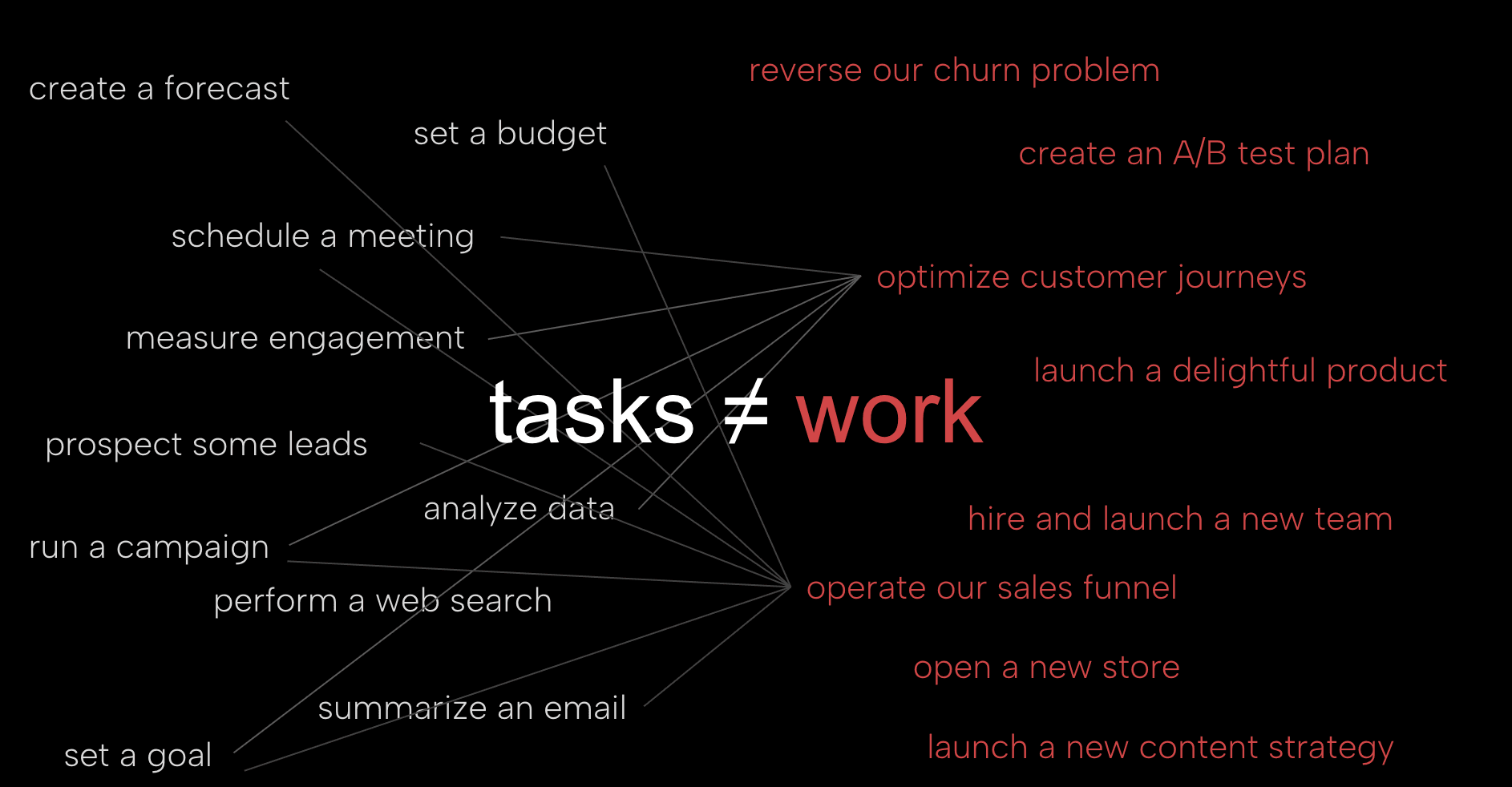
A lot of AI progress is framed around task completion. AI can summarize an email. It can draft a response. It can create a forecast, schedule a meeting, analyze data, measure engagement, prospect leads, run a campaign, or generate an A/B test plan.
Those are useful tasks. But tasks are not the same thing as work.
Work is not "summarize an email." Work is "reverse our churn problem."
Work is not "create a forecast." Work is "launch a new store."
Work is not "perform a web search." Work is "launch a new product line that customers love, that arrives on time, with healthy margins, that moves our brand forward."
“A business does not care if tasks were completed. It cares that results were delivered.”
In the age of AI, a business does not care if tokens are spent, it cares about the ROI for those tokens. Today's hype around tokenmaxxing just rewards cost and toil rather than reward and efficiency. It is a measure of org transformation (who is using AI and how much of it), but not a measure of success.
It should be no surprise then that tokenminning is becoming the latest buzz word as organizations are beginning to discover the trap of measuring usage and not reward. Walmart recently introduced token limits after their AI initiatives highlighted broad redundancy across teams. Just today, it was announced that Amazon is distilling Claude's models into cheaper, smaller models to manage costs. As AI adoption increases, if we're not careful, redundant agents get deployed, token usage goes up, and these agents complete tasks that do not move the business direction forward. In its worst case, we have shifted human cost to compute cost with little added benefit, or the return on investment is eaten up by unobserved redundancy.
That is where human judgment remains central.
The Simple Loop Works Well for Predictable Work
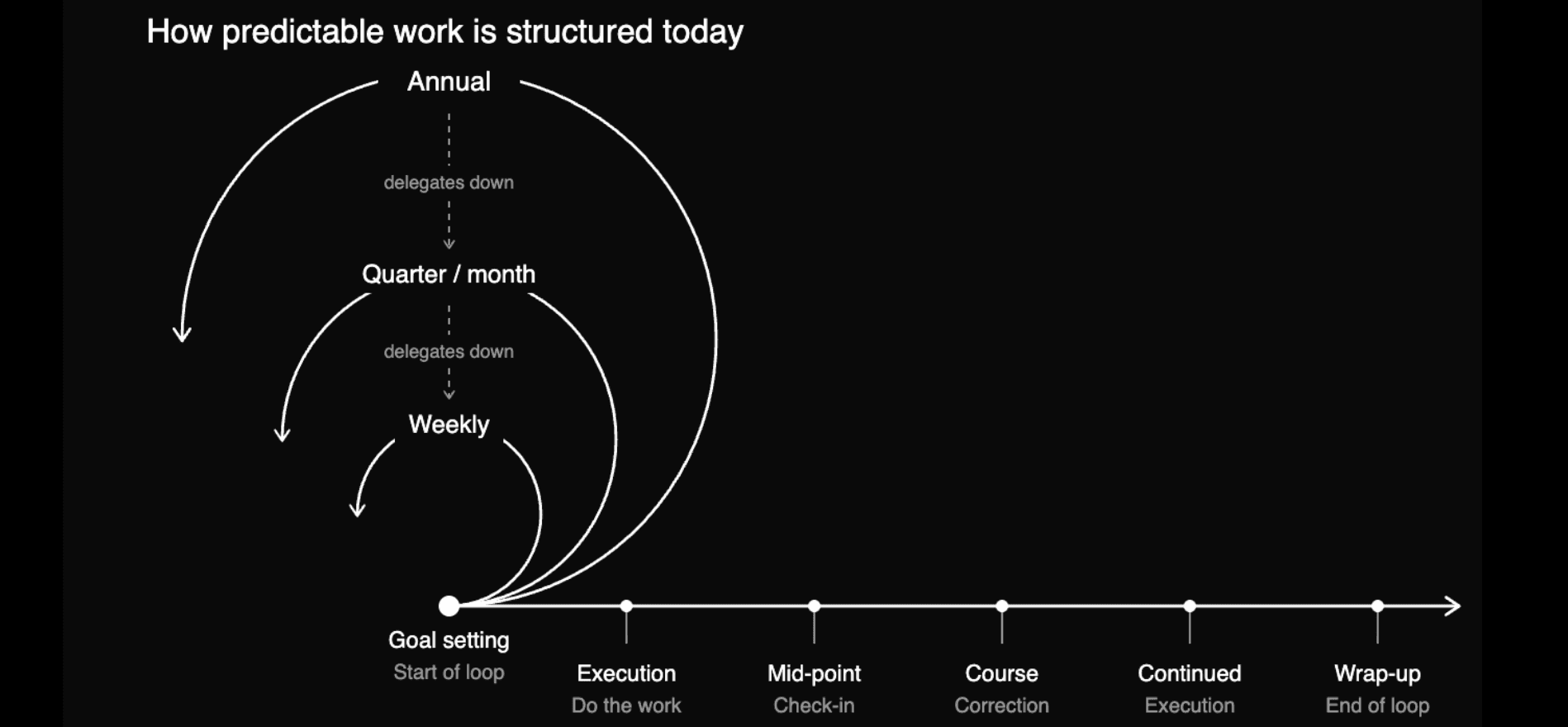
For predictable work, we already have a familiar operating model. At the beginning of a loop, we set a goal. Then we execute. We check progress. We correct course. We continue executing. Eventually, we wrap up the loop and start again.
This structure can exist at many levels. Each year I set developmental goals for myself, then I execute on my work while also improving my skills, hoping to develop my skillset further. Next year I update those goals based on the times and where I land at the end of the year.
In this model, AI can be extremely effective. It can help generate plans, write drafts, analyze results, measure progress, identify trends, and produce reports. It can accelerate the mechanics of execution.
This is why AI feels so powerful in software. The work often fits the loop. The goal is clear enough. The execution path is tactical enough. The feedback arrives quickly enough. The system can tolerate a certain amount of trial and error.
But many major business decisions do not work that way.
Strategic Work Runs Across Multiple Timescales
Retail is a good example. A retail business is not only optimizing what happens this week. It is also making bets about next month, next season, and next year. Each timescale has its own logic, its own goals, its own constraints, its own budgets, its own supplier relationships, its own transportation contracts.
At the weekly level, the work is tactical. Teams are reviewing last week's performance, investigating anomalous dips, adjusting ad budgets, changing email campaigns, deciding which products to feature, walking stores, giving feedback to associates, evaluating A/B tests, and reacting to immediate customer behavior.
At the monthly, quarterly, or seasonal level, the work becomes more speculative. Buyers, planners, marketers, store directors, and operators are thinking about what comes next. What products should we source? Which suppliers should we trust? Which suppliers created quality issues last year? What did returns look like? What happened to effective margin? What designs are trending across competitors, social media, and culture? What customer signals are emerging now that might matter months from now?
This is not just execution. It is judgment under uncertainty.
At the 12-to-18-month level, the work becomes strategic. A business may be trying to prove that its brand can appeal to a younger customer. Or that it can turn around operations. Or that it can scale manufacturing. Or that it can build a new sales channel. Or that it can expand into a new geography.
These are not weekly optimizations. They are transformations.
The challenge is that all three timescales are active at once. The weekly plan needs to support the seasonal plan. The seasonal plan needs to support the annual strategy. And the annual strategy needs to remain grounded in what is actually happening in the business right now.
No single AI optimization loop can manage that on its own.
Real Work Is Constantly Interrupted
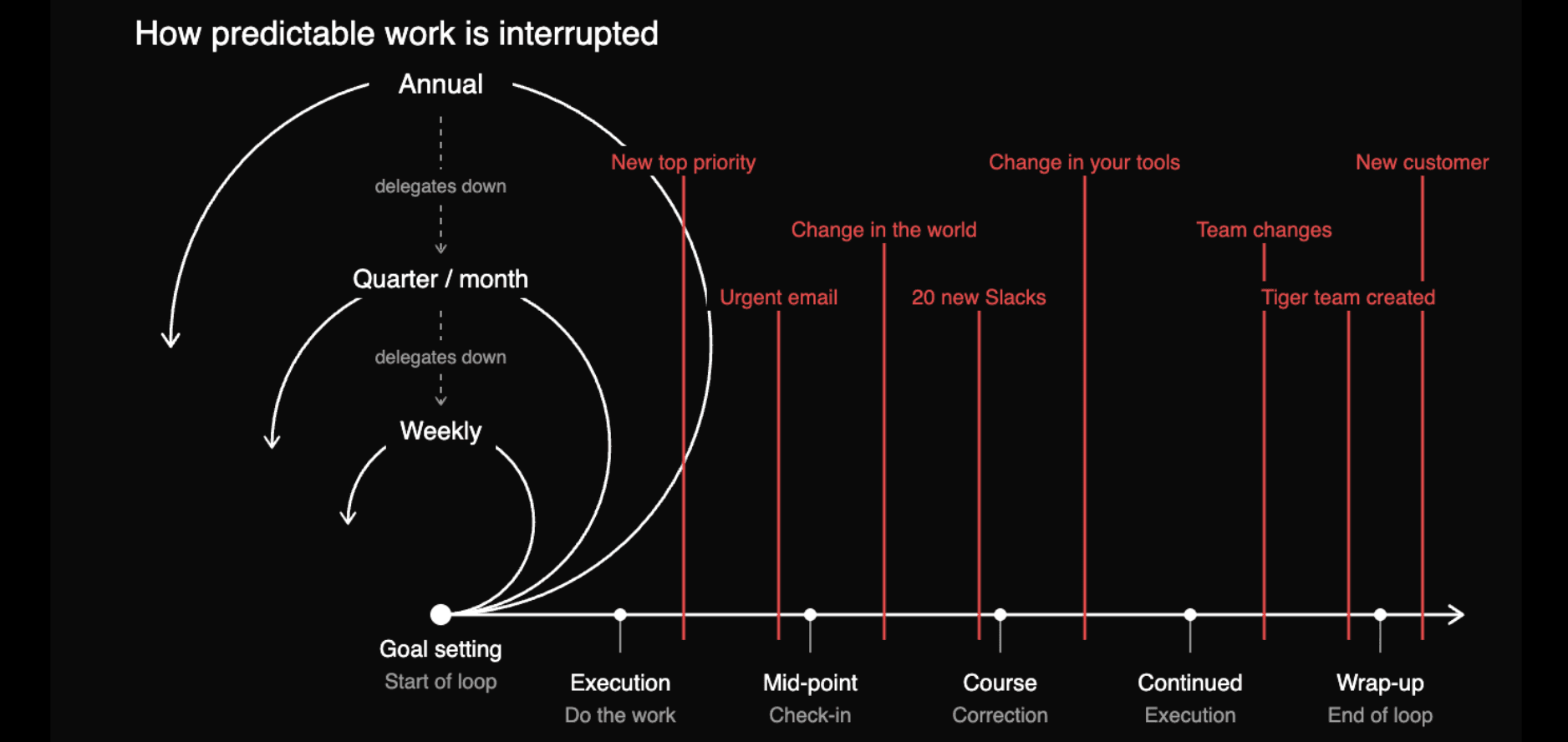
Even the multi-timescale model is oversimplified. Work just isn't this predictable. It is often interrupted. A team may start the week with a plan, only to be hit by an urgent email, a new executive priority, a sudden drop in demand due to a world event, an underperforming store, a product that suddenly takes off, a team reorganization, or a supply chain disruption.
These interruptions are not noise. Ignoring them can mean sizable losses. Reacting to every single interruption though can also mean failing to execute in your day to day.
“The hard part is deciding whether the next task is still the right task when other things have changed.”
This is why the idea of a single autonomous agent running a clean loop is too simplistic. The hard part is not just doing the next task. The hard part is deciding whether the next task is still the right task when other things have changed. That requires context, prioritization, a codified relationship between the short-term execution and long-term strategy. Today, humans do this by asserting their best judgement.
AI Should Help Humans Navigate the System
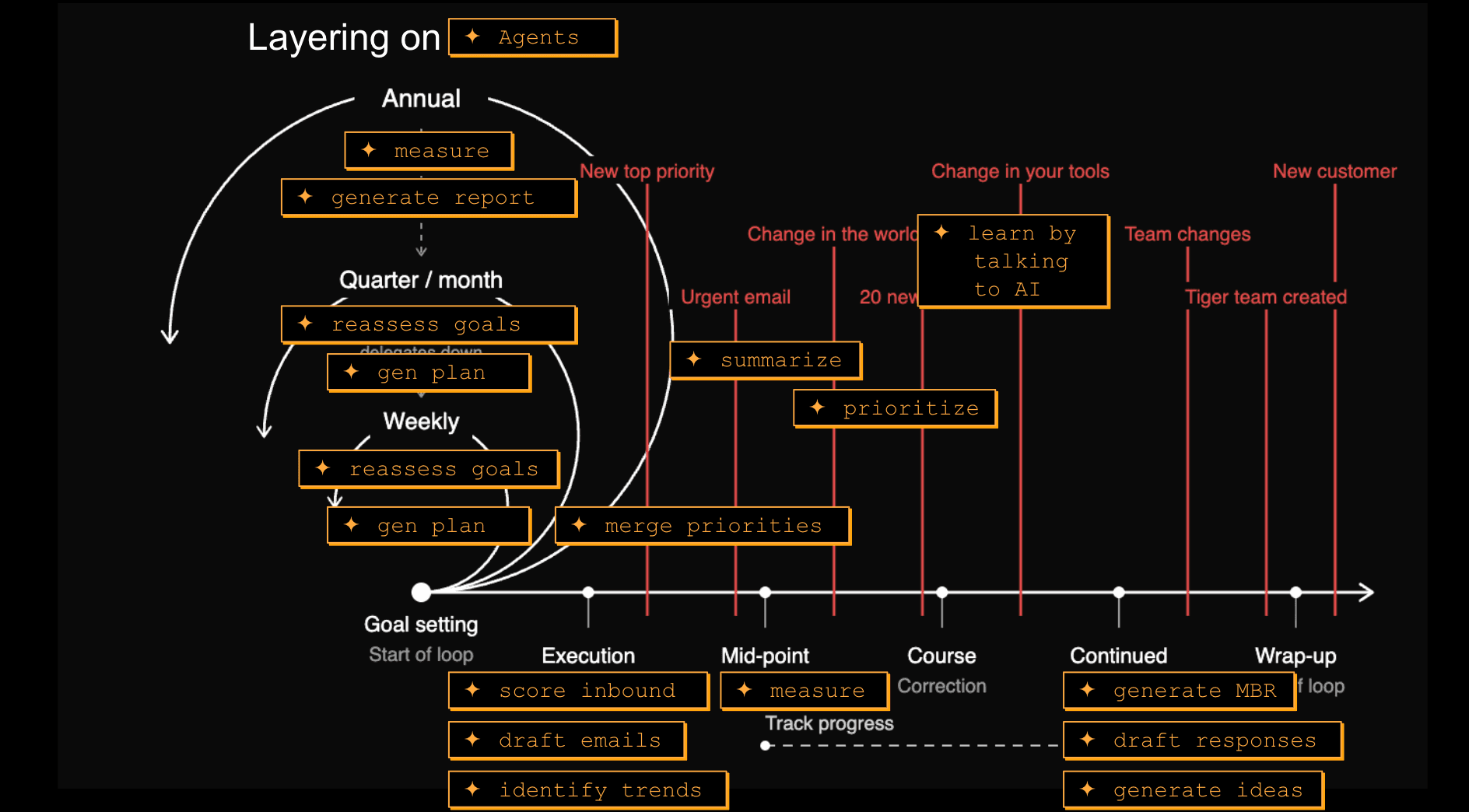
In complex operating environments, AI should not be treated merely as a task-completion engine. It should be treated as a system for helping humans navigate information, uncertainty, and competing priorities.
AI is well suited to the work that overwhelms people: mining data, detecting anomalies, searching across fragmented systems, summarizing noisy inputs, surfacing risks, identifying opportunities in the long tail, drafting options, generating scenarios, and helping teams understand what changed.
In retail, that might mean an AI system that helps a weekly operator understand why performance dipped last week. Another agent might help a seasonal planner compare supplier quality, return rates, margins, and trend signals. Another might help an executive understand whether current execution is actually advancing the company's 12-to-18-month strategy.
Each agent may have a semi-myopic view of its own timescale. That is a feature, not a bug. Weekly execution requires focus. Seasonal planning requires a different kind of focus. Long-term strategy requires still another.
But those layers need to talk to each other. The weekly plan should be interruptible by the seasonal goal. The seasonal plan should be evaluated against the annual strategy. The annual strategy should be informed by what is happening in the market, in stores, in customer behavior, and in the operating data.
AI can help coordinate those loops. But it should not pretend that the loops are simple.
Some Decisions Are Not Two-Way Doors
This matters because many business decisions are not easy to reverse. You can regenerate code. You can rewrite a prompt. You can run another test. But you cannot casually unwind a major inventory buy, a supplier commitment, a store opening, a manufacturing decision, or a brand repositioning.
These are not "vibe coded" decisions. They involve capital. They involve people. They involve timing. They involve operational constraints. They involve opportunity cost. They involve consequences that may persist for years.
“The best use of AI in these environments is not to remove the human. It is to help the human see more clearly.”
That does not mean AI should stay away from them. It means AI should be used to improve the quality of human decision-making, not to bypass it.
The Future of AI Workflows Is Multi-Timescale
The businesses that get the most out of AI will not simply be the ones that automate the most tasks. They will be the ones that understand how to execute business strategies through AI.
They will recognize that a complex business operates across multiple timescales, responds to exogenous events, and often involves decisions that are one-way doors. The real opportunity for AI is to help humans operate inside that complexity. To help them reconcile short-term and long-term goals. To surface the right signal at the right time. To connect the task in front of them to the larger work that actually matters.