
 Follow
Adobe Digital Insights measured the average U.S. retail product page at just 66% machine-readable in its March 2026 AI traffic analysis — meaning roughly a third of the content on the page where a shopper actually decides to buy can't be parsed by an AI agent at all.
That gap sits underneath a channel that just went live. Google launched the Universal Commerce Protocol (UCP) at NRF's January 11, 2026 conference — co-developed with Shopify, Target, Walmart, Etsy, and Wayfair, and endorsed by more than 20 partners including Visa, Mastercard, American Express, and The Home Depot. UCP lets a shopper discover and check out a product inside Google Search's AI Mode or Gemini, without ever landing on the retailer's site. ChatGPT Shopping and Perplexity Commerce are running the same play.
None of these agents look at a product page the way a person does.
“None of these agents look at a product page the way a person does.”
Agents Don't Shop. They Query.
A human shopper on a product page absorbs a hundred signals at once: the photography, the copy, the layout, the brand's whole visual argument for why this jacket is worth $180. An AI shopping agent absorbs none of that. It queries a structured feed — attributes, a stable identifier (GTIN, MPN, SKU), price, availability — and it does not infer what isn't there.
If a product's material, size, color, or identifier is missing from the feed, the agent doesn't guess. It drops the product and moves to the next one that has the field filled in.
For a merchandiser, that inverts decades of instinct. The photography, the copy, the vibe — the brand differentiation a team spends most of its budget on — is exactly what doesn't reach the agent. When the shopper is software, the contest comes down to whose data is more complete.
Toolient, a product-feed optimization firm, put a number on it. In a production audit of one U.S. Shopify catalog, AI shopping assistants ignored more than 40% of the store's inventory — not because the products were bad, but because the feed lacked structured attributes and stable identifiers. Catalogs with near-complete attribute data — what the industry has started calling a "Golden Record" — showed 3 to 4 times the visibility in AI recommendations that sparse-data catalogs did.
That's one vendor's audit of one catalog, so treat it as a single data point. But Adobe's broader measurement — a third of the average product page unparseable — points the same way, from a different method and a different company.
The Failure Doesn't Show Up as a Page View
When a human shopper skips your product, you see it: a page view with no add-to-cart, an impression with no click, a session that bounces. Every analytics stack in retail is built to catch that.
When an AI agent skips your product, you see nothing. The shopper never lands on your site. There's no impression, no bounce, no abandoned cart — because the agent filtered the SKU out of consideration before a session could ever start. The event your funnel is built to detect never fires.
A SKU an agent skips just looks like flat demand.
“A SKU an agent skips just looks like flat demand.”
That's true today — and only because agents are still a single-digit slice of referrals, the same sub-10% share the model in the next section starts from.
Give the agents a few more points of share and flat demand turns into negative demand. As the channel climbs toward McKinsey's ~18%-of-spend path for 2030, the agents don't just fail to add sales — they take the shoppers who used to find the product on their own. The SKU's sales fall even though real demand for it hasn't, and a buyer watching those sales marks it down or drops it: the wrong call for a product that was selling fine to every human who could still see it.
This isn't a slow report catching a real signal late. It's a channel with no instrumentation at all — the demand was there, the agent ran its query, and your catalog wasn't in the set it chose from. Nothing in a standard reporting stack — traffic, conversion rate, even organic search rank — was built to catch a rejection that happens before a session begins.
What a Structured Catalog Is Actually Worth
A simple illustrative model makes the scenario concrete. We built a synthetic catalog: 8,000 SKUs, $220 million in annual revenue, a realistic long-tail revenue distribution. Following Toolient's audit, we put 40% of SKUs in a "sparse" attribute tier, 40% in "partial," and 20% at full "Golden Record" completeness — a stated, illustrative mix. Golden Record SKUs get a 3.5x visibility multiplier over sparse ones, the midpoint of the reported 3–4x range, with partial SKUs at the geometric mean.
Then we modeled how much agent-reachable revenue each tier captures as agent-driven traffic share grows from 2026 toward 2030. For the growth path we used McKinsey's October 2025 estimate that agentic commerce could reach $900 billion to $1 trillion of U.S. B2C retail spend by 2030 under its moderate scenario — about 18% of spend. We start at a conservative 6% in 2026, since today's data on AI-shopping-assistant use (the IBM-NRF study found 45% of consumers already turn to AI somewhere in a buying journey) measures research and assistance, not completed agent transactions.
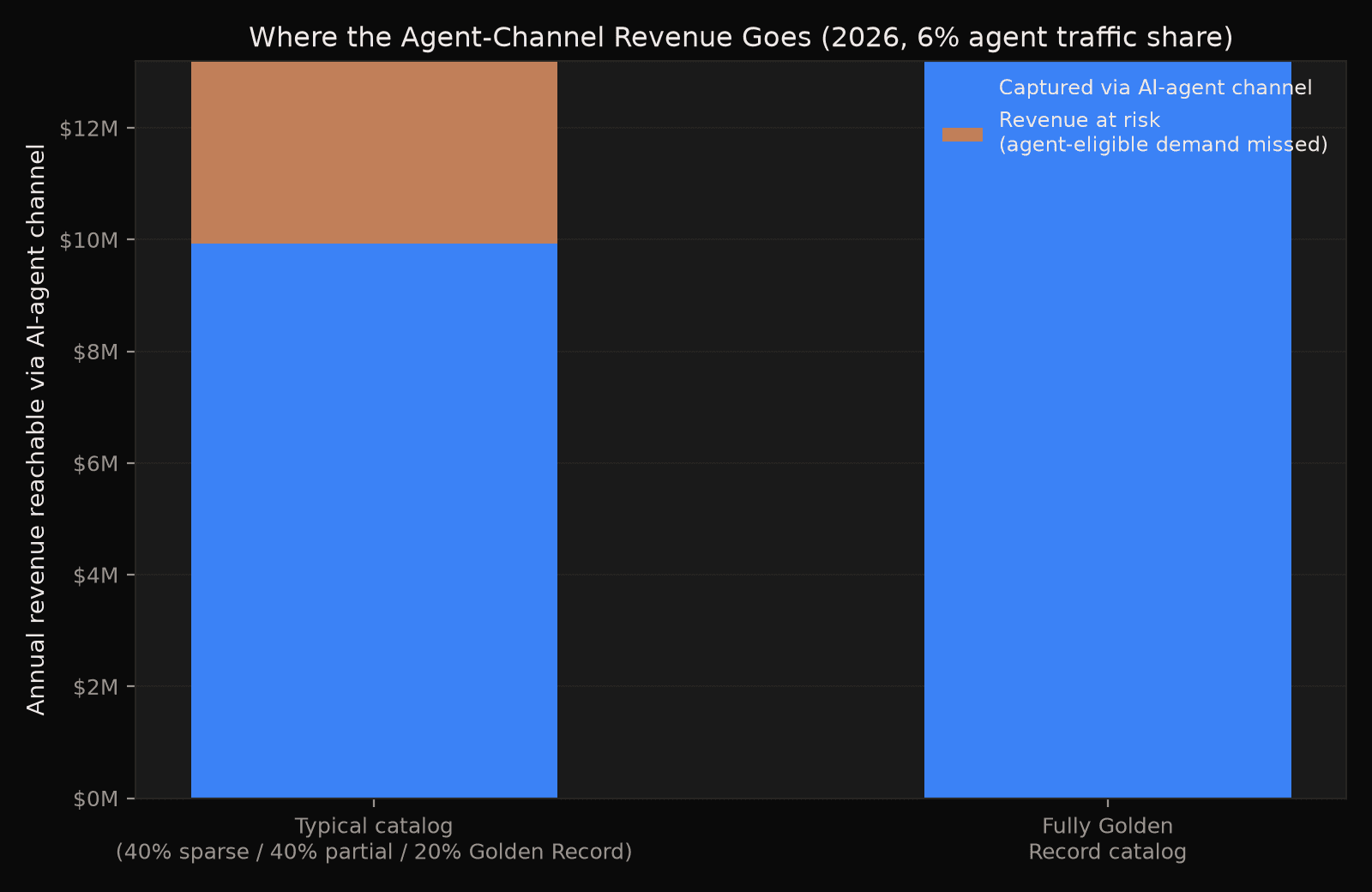
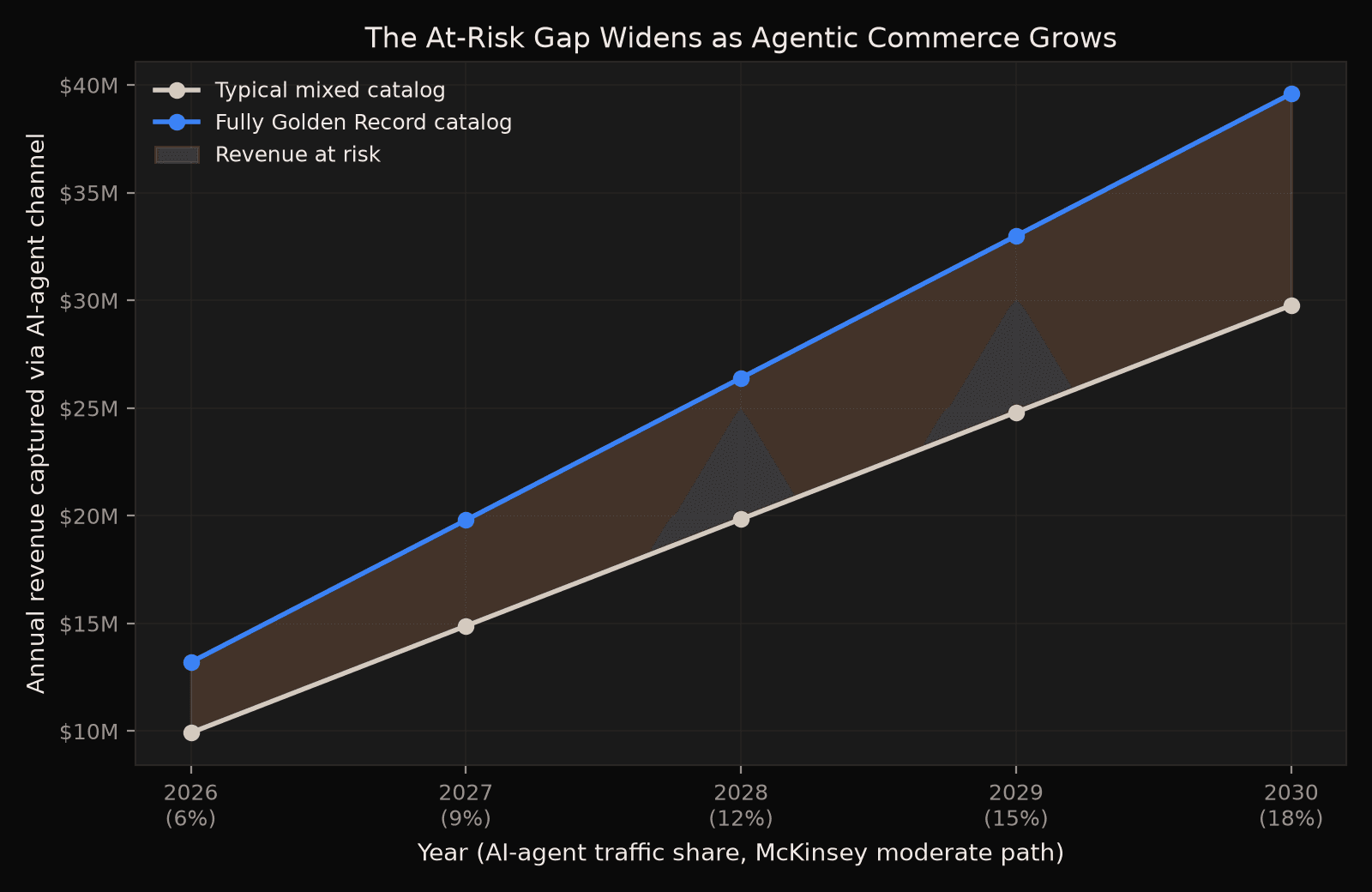
Under those assumptions, a typical mixed-tier catalog captures about $9.9 million of its $220 million in agent-reachable revenue in 2026, versus $13.2 million for an equivalent fully Golden Record catalog — a gap of $3.3 million a year, or about 1.5% of total revenue. By 2030, at McKinsey's moderate 18% agent-traffic share, the same gap widens to $9.8 million a year, or roughly 4.5% of revenue.
The gap grows every year agentic commerce grows, because it scales with traffic share, not with the level the catalog is stuck at.
The Gap Is Real Even If You Don't Believe the 3-4x Number
The multiplier comes from one vendor's single-catalog audit, so we stress-tested it.
At the reported 3–4x, the 2030 gap runs $9.0–$10.5 million a year. Drop the advantage to a much less generous 1.5x — barely better than chance — and the gap is still $4.1 million a year in 2030.
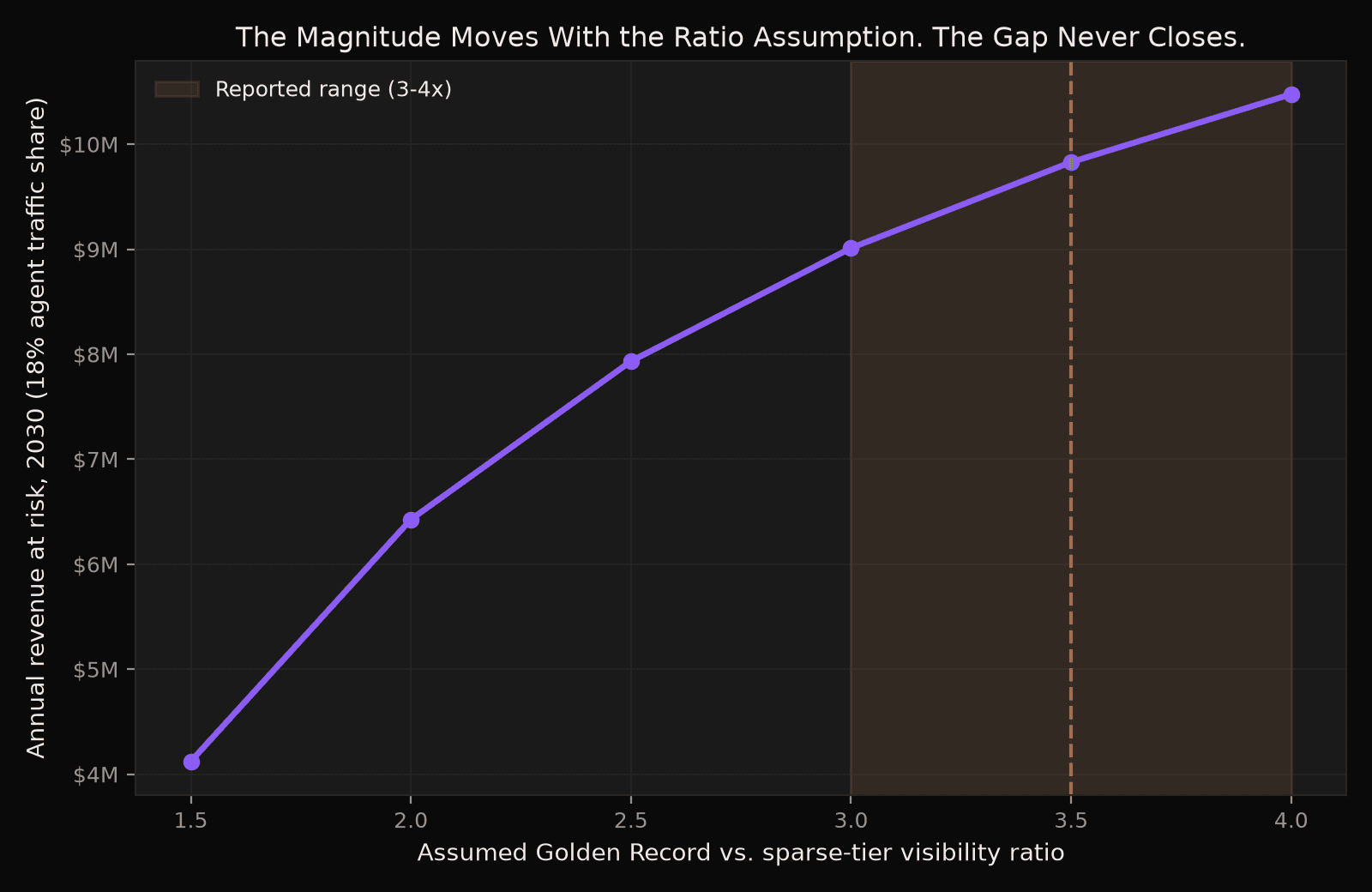
Every ratio we tested still leaves a multi-million-dollar gap — even the deliberately conservative 1.5x case.
“Every ratio we tested still leaves a multi-million-dollar gap — even the deliberately conservative 1.5x case.”
The same holds for the growth assumption. If agent traffic barely moves past today's level — an 8% skeptical case instead of McKinsey's 18% — the 2030 gap is still $4.4 million a year. And Shopify's own numbers argue against the skeptical case: the company told investors that AI-driven traffic to its merchants' stores rose about 7x and AI-driven orders about 11x in the ten months after January 2025 — a small base moving fast, which is the shape McKinsey's forecast assumes.
The typical catalog's revenue-weighted capture rate (75%) comes out better than its 40% sparse share would suggest, because bestsellers get more merchandising attention than the long tail and are more likely to already carry complete data. So the gap sits in the long tail — new launches, niche SKUs, items nobody's finished documenting. A missed sale on one of those already reads as background noise in a conversion report, because each SKU's revenue is small enough that nobody watches it closely. Those are also the SKUs an agent is least likely to surface. The products nobody documents are the first ones the agents can't see.
Listed Isn't the Same as Eligible
The conventional merchandising KPI is percent of catalog live: is the SKU published, priced, and in stock. That number tells you nothing about whether an AI agent will ever consider recommending it.
Listed isn't the same as eligible.
“Listed isn't the same as eligible.”
A better number is percent of catalog eligible for AI-agent recommendation — complete attributes, a stable identifier, structured enough that an agent's query actually matches it. A retailer can run 100% of its catalog live and still have 40%+ of it shut out of the fastest-growing discovery channel in retail, with every dashboard in the building reading green.
That's the pivot ops and merchandising teams need to make before the traffic share in the chart above gets much bigger than 6%.
Eligible Has to Reach the Aisle, Too
Even now, about 80% of U.S. retail happens offline — e-commerce was roughly 16% of total retail sales in early 2025, per the Census Bureau. The agent channel we've been sizing is a slice of the online minority.
The same record that makes a SKU eligible online is what lets an agent answer the question behind the other 80% of spend: can I get this today, near me? Local inventory counts, store hours, address, aisle location — the fields that connect an online listing to a physical shelf. Without them, an agent can find the product and still send the shopper to a competitor who can say where it's in stock right now.
So the same record that wins an online recommendation tells a shopper which store has the item on the shelf right now — and in-store is still where roughly 80% of the money changes hands.
“The same record that wins an online recommendation tells a shopper which store has the item on the shelf right now.”
Product Data Was Always the Bottleneck
The argument here is twenty years old. The manual, physical, judgment-heavy parts of the business — assortment, attribution, the unglamorous work of making sure every SKU is described correctly — are what decide whether the flashy channel on top of them works. The incentive to get product data right isn't new; agentic commerce just turned the cost of skipping it into the revenue gap this post has been adding up.
That's the work Waveform is built for — connecting a retailer's real data, reading what's actually in the catalog, and surfacing the gaps that otherwise sit unmeasured until a new channel makes them count.
And it doesn't start with the manual attribution the gap is made of. Waveform reads a catalog with no pre-attributed data to lean on — indexing products visually and from the structured and unstructured text already scattered through the catalog, then relating each one to popular trends and other demand signals. Nobody has to hand-tag the catalog field by field first. That's one of the more interesting problems in retail data right now, and we get to build for it.
Methodology. The $220M catalog, its long-tail revenue distribution, its 40% / 40% / 20% sparse / partial / Golden Record tier mix, and every dollar figure above came from a simple illustrative model. It tests a direction — that the completeness gap costs more every year agentic commerce grows, and never closes even under conservative assumptions — while the exact dollar figures scale with the tier-mix and traffic-share assumptions stated throughout.